We ask how floral curvature, the relative positions of organs, and structures hidden from the outside shape floral function and evolve across species.
3D floral atlas
We ask how living flowers can become reliable, botanically interpretable 3D data. We have sampled flowers from more than 300 species, with sampling continuing through NYBG’s Living Collections and reconstruction supported by our turntable-based workflow for automated batch photogrammetry, Whorlet. Selected reconstructions and qualitative comparisons across methods are available in the 3D exhibit.
The NYBG Pilot project focuses on standardized capture, quality assessment, and linking geometry with specimen metadata and organ annotations. Planned work explores aligning intact flowers with dissection or slice evidence to recover hidden structures, alongside multimodal reconstruction approaches.
Supported by the NYBG Pilot Projects Initiative, 2026–2027.
Floral convergence and diversification in Pedicularis
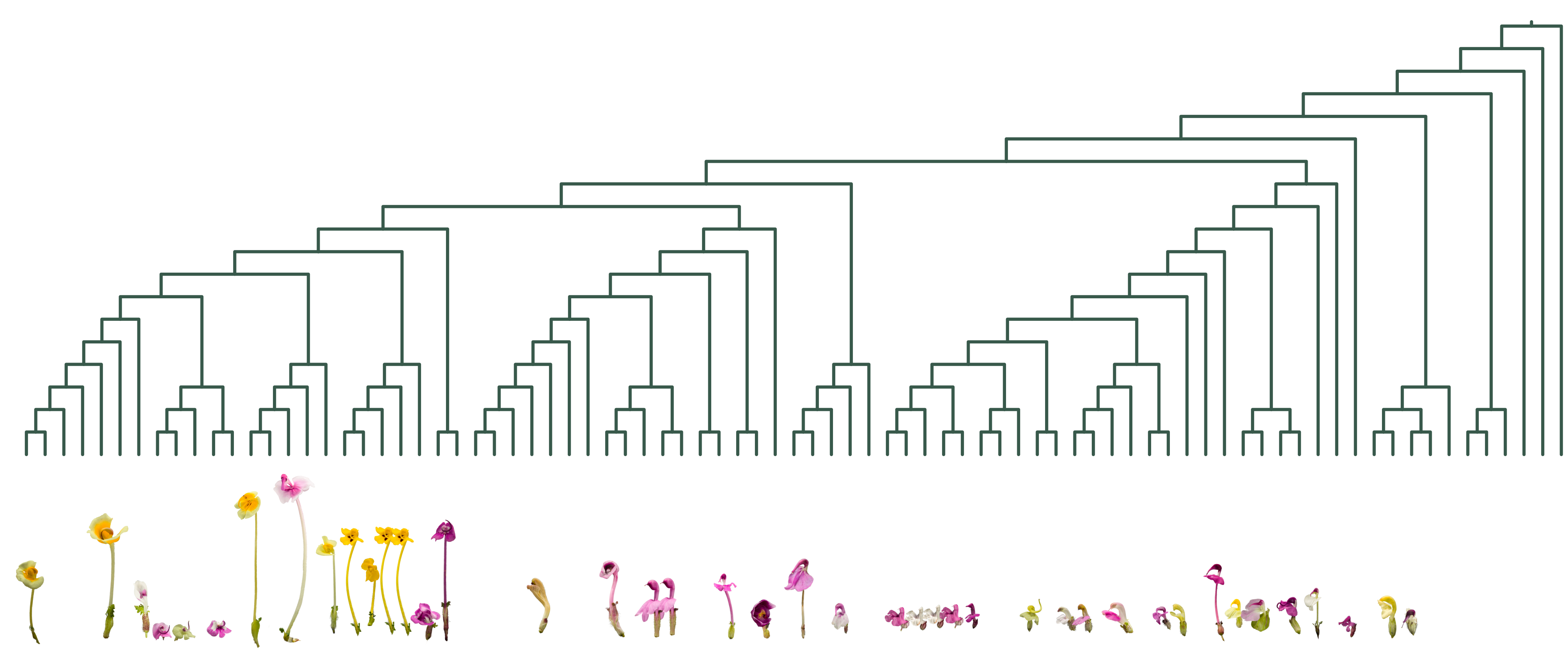
Repeated changes in floral shape and color make Pedicularis a setting for studying convergence during rapid diversification. We connect complex corolla and galea shapes, flower color, and pollination-related traits with the evolutionary history of plants in the Hengduan Mountains.
We combine genomic, transcriptomic, and 3D data to examine these repeated changes in a phylogenetic framework. A chromosome-scale genome study is in preparation.
Developed through long-term collaboration with the Eaton Lab.
Evolution of the shape and scent in Bulbophyllum orchids
We combine 3D phenotyping and floral volatile profiling to investigate how floral shape and scent evolve in Bulbophyllum and when changes in these traits are associated.
Loading 3D view…
Bulbophyllum phalaenopsis · Photogrammetric reconstruction
Three-dimensional data capture curvature, orientation, and spatial relationships among floral organs. Phylogenetic comparisons will help us examine how this diversity relates to chemical signals and floral function.
A collaboration with Dr. Georg Jander (Boyce Thompson Institute) and Dr. Robert Raguso (Cornell University), supported by NYBG–BTI Collaborative Seed Funding through the Triad Foundation.
PhyloShape
We are developing PhyloShape to compare three-dimensional morphology in a phylogenetic framework. The challenge is to represent complex shapes while retaining differences that can be interpreted biologically.
Its ancestral shape reconstruction uses corresponding morphological points and a phylogenetic tree. This connects comparisons of living species with questions about how their forms changed over time.
We investigate plant relationships and genome evolution, including how conflicting genomic histories inform our understanding of diversification. Organelle genomes are a major interest: we study their assembly, structural variation, and evolution alongside evidence from other genomic compartments.
Organelle Genome Assembly
GetOrganelle
GetOrganelle recovers organelle genomes from short-read genome-skimming data, where target reads occur alongside sequences from other genomic compartments. It combines read recruitment, de novo assembly, and graph analysis to recover target sequences and assess their possible connections. We are developing support for long-read sequencing data.
Assembly graphs retain evidence for alternative sequence arrangements, and GetOrganelle can report multiple possible configurations supported by the assembly graph (Jin et al., 2020).
A mixed DNA sample may contain several genomic variants that share sequence. Traversome uses a graph-based likelihood framework to infer sets of variants and their relative frequencies from long-read paths through an assembly graph.
Organelle genomes are an important application of this broader mixed-genome problem.
Plastid genome structure and evolution in Fabaceae
We investigate how plastid genome organization and gene content change during legume diversification. Reconstructing this history requires a phylogenetic framework. We have examined conflicting signals within plastid data (Zhang et al., 2020). A broader study used plastid, mitochondrial, and nuclear data to examine legume relationships. Its analyses support a major role for incomplete lineage sorting in phylogenetic conflict, with gene flow also contributing to plastid–nuclear discordance (Zhang et al., 2026).
In Cercidoideae, we documented inversions, shifts in inverted-repeat boundaries, and coexisting plastome arrangements in sampled Tylosema (Wang et al., 2018). Ongoing analyses connect these structural changes with evolutionary history, with attention to annotations, homologous regions, and assembly evidence.
We examine the evidence behind plant organelle genome assemblies and structural interpretations, asking how Claude-assisted reasoning can help assess whether biological conclusions are supported by the underlying data.
Supported by the Anthropic AI for Science Program.